
Tobacco Rattle Virus in Peonies: A Guide for Alaska Growers
Peony grower reference
By Andrea Garfinkel, Puyallup Research and Extension Center, Washington State University; Todd Steinlage, Alaska Department of Natural Resources, Division of Agriculture, Palmer, AK; Janice Chumley, Cooperative Extension Service, University of Alaska Fairbanks; and Gary Chastagner, Puyallup Research and Extension Center, Washington State University.
Source: Washington State University Extension publication FS284E, published July 2017. Republished with permission. Because diagnostic lab contacts and submission requirements can change, verify testing information before sending samples.

What is Tobacco rattle virus?
Tobacco rattle virus (TRV), previously referred to as Peony ringspot virus or Peony mosaic virus, is one of the most widespread viruses of peonies. There have been reports of this virus throughout Asia, Europe, New Zealand, and North America. TRV can infect both herbaceous (Paeonia lactiflora) and tree (Paeonia suffruticosa) peonies.
Although first described in tobacco, TRV has a wide host range of over 400 species, including aster (Aster spp.), barley (Hordeum vulgare), beans (Phaseolus vulgaris), beets (Beta vulgaris), brassicas (Brassicaceae), cocklebur (Xanthium spp.), common chickweed (Stellaria media), corn (Zea mays), cucumber (Cucumis sativus), faba beans (Vicia faba), gladiolus (Gladiolus spp.), iris (Iris spp.), lambsquarters (Chenopodium album), daffodil (Narcissus spp.), oat (Avena sativa), onion (Allium cepa), peas (Pisum sativum), petunia (Petunia × atkinsiana), pepper (Capsicum spp.), pigweed (Amaranthus spp.), potato (Solanum tuberosum), purslane (Portulaca oleracea), rye (Secale cereale), shepherd's purse (Capsella bursa-pastoris), spinach (Spinacia oleracea), sunflower (Helianthus annuus), tulip (Tulipa spp.), and wheat (Triticum spp.). Many of these hosts are symptomless.
TRV infection of potato can cause stunting, foliar symptoms such as mottling, yellow ringspots, or line patterns, stem mottling, and tuber deformation and symptoms known as corky ringspot, or spraing. These potato symptoms can lower the value of a shipment or make it unmarketable. The virus often remains localized to the roots of infected hosts, but in peony and potato it may express in the leaves. Some of these hosts can play an important role in the epidemiology of the pathogen on peony.
Tobacco rattle virus particles are rod-shaped and are composed of two single-stranded RNAs. Lengths of both particles vary by isolate. RNA-1 is 185 to 196 nm long, and RNA-2 is approximately 50 to 115 nm long. The diameter of both particles is approximately 23 nm. Given that a nanometer is one-billionth of a meter, these particles are extremely small and can only be seen with an electron microscope.
RNA-1 contains all the genes needed for replication, and RNA-2 contains the gene necessary to produce the coat protein. The so-called “M-type” isolates contain both RNA particles and are nematode and mechanically transmissible. “NM-type” isolates only contain RNA-1, do not form a particle, are not nematode transmissible, and are more difficult to transmit mechanically. Both “M” and “NM” type isolates have been detected in peony. The type of TRV isolate present can affect detection: isolates lacking a coat protein cannot be detected using antibody-based tests such as ELISA and must be detected using molecular methods such as PCR.
What are the symptoms of TRV in peony?
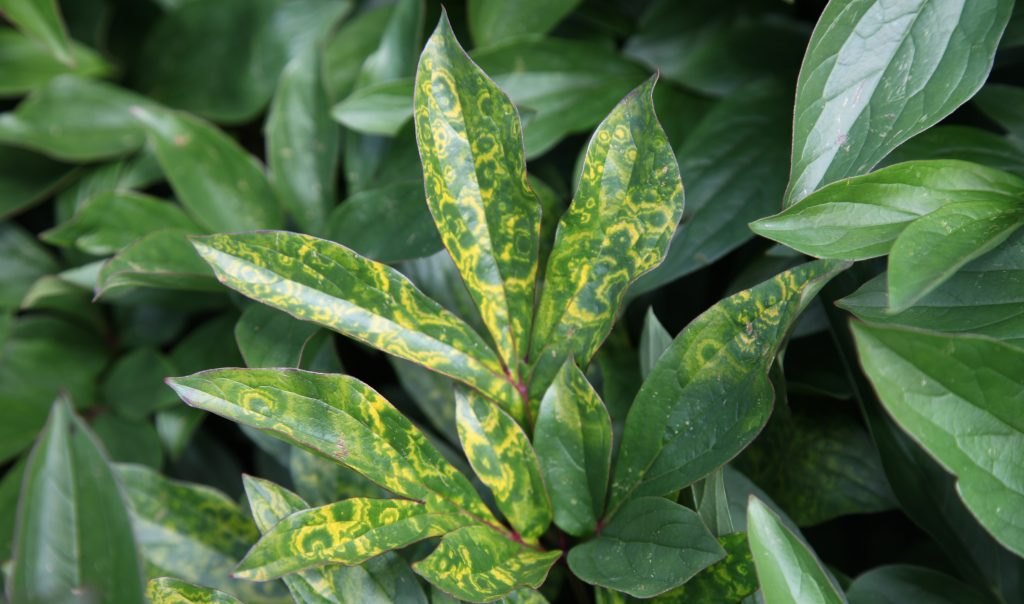
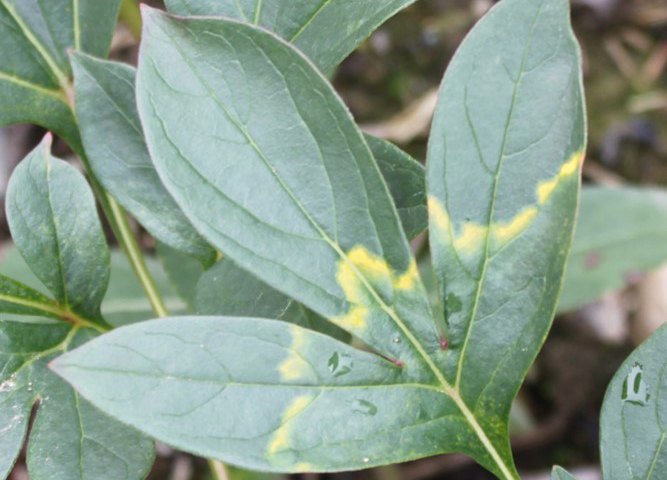
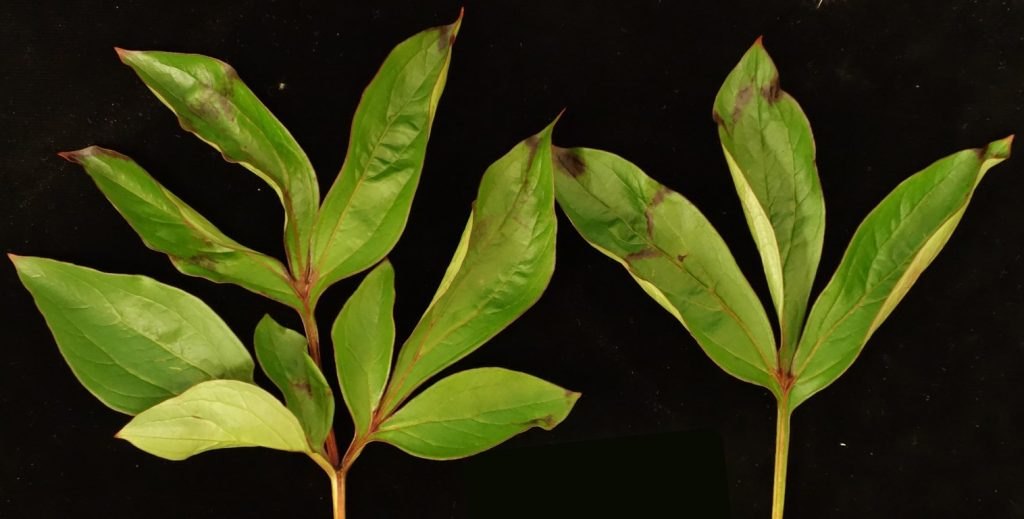
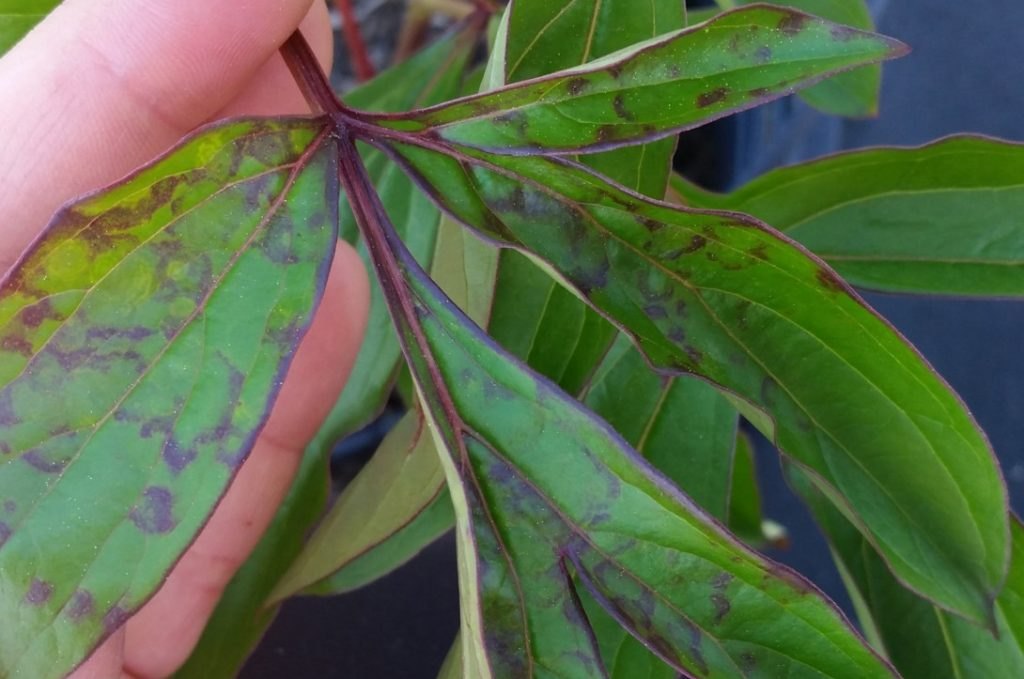
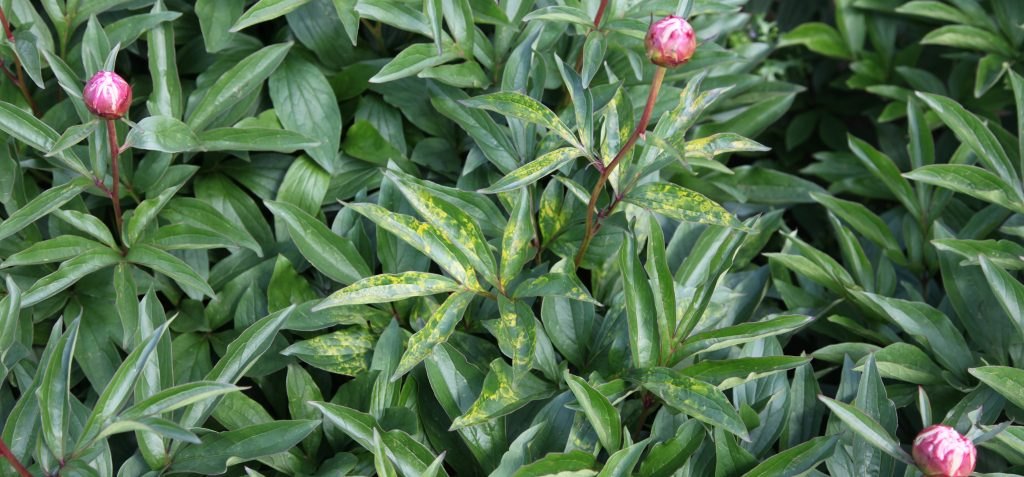
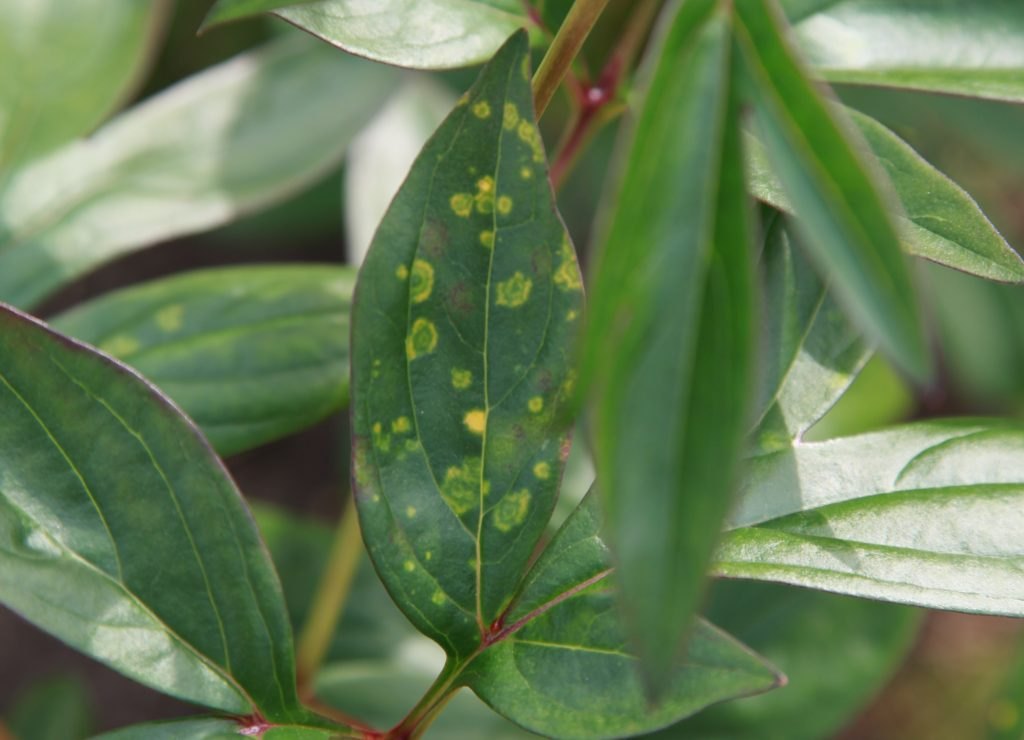
TRV in peonies is most commonly expressed as ringspots of alternating green and yellow concentric circles or as a yellow-green mottle or mosaic. Symptoms can also appear as yellow line patterns or chevrons, and symptomatic tissues can turn purple or red in certain conditions. These symptoms can affect marketability of a whole plant or stems if present during flower harvest. There are no known symptoms of TRV expressed in the flower, and it is unclear how the virus affects plant productivity; however, observations suggest there is no marked reduction in the vigor of infected plants.
Symptom expression of TRV in peonies, like many viruses, is highly dependent on environmental conditions. Symptoms will often appear during cooler parts of the growing season and are largely absent during warmer months. Symptoms may also be apparent in only part of the plant while the remainder of the plant appears healthy. Even if symptoms are not visible, if any parts of the plant show or have ever shown symptoms of TRV, it is likely that the entire plant is infected with the virus. It is not possible to remove only infected plant parts or cure a peony of TRV.
Peonies are also susceptible to other viruses, such as Tomato spotted wilt virus (TSWV), the symptoms of which can resemble TRV. TSWV can also cause economic damage to peony and many other host species, but requires different management strategies than TRV.
How did TRV get into my field?
If TRV symptoms are present in a first-year planting, infected rootstock are the most likely method of introduction. Due to the potentially fleeting nature of TRV symptoms, infected plants can be dug, divided, and sold without the supplier knowing the plant is infected. Each root piece cut from an infected plant will contain the virus; therefore, it is not unreasonable to observe a small percentage of new peony plants infected with TRV. If a large percentage of a new planting is infected with TRV, it may be worth notifying the supplier.
Rootstock producers who plant back their own stock may unknowingly be dividing infected plants and increasing the proportion of infected rootstock in their field. Healthy rootstock can also be infected by nematodes that acquire the virus from a previous crop or nearby infected host.
It is also possible for a healthy plant to become infected with the virus by a nematode vector or by mechanical transmission after being planted into a field. TRV does not survive in the soil absent of its nematode vector.
How does TRV spread?
The “M-types” of TRV are transmitted by nematodes in the genera Paratrichodorus and Trichodorus, known collectively as stubby root nematodes. Trichodorid nematodes are migratory ectoparasites, meaning they live outside the plant, and feed with a toothlike or needlelike stylet. The nematodes pick up the virus from an infected plant by feeding on the roots and then can transmit the virus to healthy plants through subsequent feeding activity. Both adults and juveniles can transmit TRV.
Once the plant becomes infected, the virus multiplies and spreads throughout the plant, or may in some cases be restricted primarily to the roots. Besides being able to transmit the virus, these nematodes do not generally cause damage to the peony. Stubby root nematodes are highly mobile throughout the soil profile and may be found from the surface to depths below 40 inches.
The nematodes are favored by abundant soil moisture and have difficulty penetrating densely packed soils with high clay, silt, or very fine sand particles (<50 µm). “NM-type” isolates have not been shown to be able to be vectored by nematodes.
The nematode vector is not present in all peony production regions. Fields throughout Alaska were surveyed in 2013, 2014, and 2015 by the Alaska Division of Agriculture for nematodes, but stubby root nematodes were not found. Stubby root nematodes have been reported in potato fields in Washington, Oregon, and Idaho, but studies have not been conducted specifically in peony fields.
TRV is also transmissible by sap under experimental conditions; however, the efficiency of this type of mechanical transmission on contaminated tools is not documented in peony. It is thought that the “M-type” TRV isolates are more stable in sap than “NM-type” isolates. TRV is not thought to spread from plant to plant by touching. Maintenance in a field between seasons may occur through the seed of some weed hosts, such as Viola arvensis, Stellaria media, and Capsella bursa-pastoris, but this is only relevant in the epidemiology of TRV in peony in areas where the vector is present.
What do I do about TRV-infected plants?
Peonies cannot be cured of TRV. Management options focus on preventing healthy plants from becoming infected through a combination of removing infected plants and reducing the potential for spread of the virus.
Management in cut flower operations may be different than in rootstock production fields. In rootstock production fields, any plants with virus symptoms should be removed, or rogued, to prevent division and sale of infected plant material. Removal of infected plants also prevents spread of the virus from adjacent plants via vector or mechanical transmission.
Rootstock producers may also take care to remove all soil from their product to ensure that stubby root nematodes are not being introduced in infested soil. This is especially true if rootstocks are being sold to and planted in areas where the nematodes are not known to be present.
In a cut flower operation, growers may choose to rogue plants, while others may choose to attempt to manage the spread of the virus without removing the plant. This is especially true in areas where the nematode vectors are not known to be present, such as in Alaska. Although the efficiency and mechanisms for mechanical transmission of TRV in peonies is not well understood, efforts to prevent mechanical transmission by sanitation of hand tools should be practiced.
TRV is in the same virus family as Tobacco mosaic virus (TMV), Family Virgaviridae, and it is possible that it will have similar responses to disinfection. Ideally, tools are disinfected between plants; disinfection after working a symptomatic or previously symptomatic plant is highly recommended. Some growers use multiple tools, so that one is soaking in disinfectant while the other is in use. Tools should first be wiped clean of excess sap or debris.
Tool disinfection options mentioned in the WSU guide
- A 1:21 chlorine bleach solution, 1 part bleach to 21 parts water, can be applied to tools for a one-minute exposure. Bleach solutions lose effectiveness after a few hours, are corrosive, and may damage eyes, skin, and clothing.
- A 2% solution of potassium peroxymonosulfate and sodium chloride, such as Virkon S, also requires one minute of soaking and is corrosive, but maintains effectiveness for about one week.
- Products combining hydrogen dioxide, also known as hydrogen peroxide, and peroxyacetic acid, such as Oxidate or ZeroTol, require soak periods of 1-5 minutes and are corrosive.
- Quaternary ammonium products, such as Green-Shield or KleenGrow, generally require longer soak periods, up to 10 minutes, and are corrosive.
- Pine oil products can also be used, generally requiring 3 to 10 minutes soak time.
Tools should be rinsed following all disinfectants. By law, all products must be used according to their label directions. Some pesticides mentioned here may not be registered for homeowner use. Readers are advised to check all applicable regulations in the state in which use will take place.
If the nematode vector is present, removal of infected plants is the only way to reduce spread of TRV. Vector control by fumigation has not been successful for many crops due to the deep distribution and high vertical mobility of the nematode.
It would be advisable to grow plants in soil that is vector-free and take measures to exclude vector and virus introduction. However, some vector nematode species have wide host ranges, including cultivated and weedy species. Therefore, in both cut flower and rootstock production systems, removal of weedy hosts can reduce reservoirs of TRV and nematodes.
If there is a question of whether the nematode vector is present in your field, soil tests are available to identify stubby root nematodes. TRV does not survive in the soil absent of its nematode vector; therefore, the virus will not spread to a healthy plant that is used to replant a site where an infected plant is removed.
Since the “NM-type” isolates are less likely to be vectored by nematodes or mechanically transmitted, removal of infected plants or tool sterilization may not be necessary if this is the only strain present in the field. Whether the “M-type” or “NM-type” is present can be determined by a series of tests, but most diagnostic clinics do not routinely determine the virus strain during diagnostic activities.
Where can I send my peonies for virus testing?
Virus infections can be positively identified by using either antibody-based tests such as ELISA or molecular tests such as PCR. When testing for TRV, a PCR-based test is preferred because an ELISA cannot detect “NM-type” TRV isolates. Testing for multiple potential viruses is advised when sending in plant material for virus indexing because other virus symptoms can resemble TRV.
The age and quality of plant tissue can affect the ability to detect the presence of the virus. Contact the testing lab about how to collect plant tissue for best results. Given the difficulty of positive identification of the virus, a negative test result should be interpreted with caution. It may be necessary to send samples during multiple times of the year or subsequent years from suspected infected plants to get a positive identification of the virus.
Most plant clinics can either test or arrange to have samples tested for TRV. The cost of testing varies between labs; contact labs directly to find associated testing charges.
Pacific Northwest university labs listed in the publication
Oregon State University Plant Clinic, Hermiston
Website: oregonstate.edu/dept/hermiston/plant-pathology-plant-lab-testing
Contact person: Robert Cating
Phone: 541-567-8321
Accepts out-of-state samples: Yes
Oregon State University Plant Clinic, Corvallis
Website: plant-clinic.bpp.oregonstate.edu
Contact person: Melodie Putnam
Phone: 541-737-3472
Accepts out-of-state samples: Yes
Washington State University, Clean Plant Center Northwest
Website: cpcnw.wsu.edu/virus_lab
Contact person: Tina Vasile
Phone: 509-786-9382
Accepts out-of-state samples: Yes
Washington State University Plant Clinic, Puyallup
Website: puyallup.wsu.edu/plantclinic
Contact person: Jenny Glass
Phone: 253-445-4582
Accepts out-of-state samples: No
Washington State University Plant Clinic, Pullman
Website: plantpath.wsu.edu/diagnostics
Contact person: Rachel Bomberger
Phone: 509-335-3292
Accepts out-of-state samples: Yes
Alaska sample testing location listed in the publication
Alaska Department of Natural Resources, Alaska Plant Materials Center
Website: plants.alaska.gov/PathologyForms.html
Contact person: Todd Steinlage
Phone: 907-745-8138
Email: Todd.Steinlage@alaska.gov
Accepts out-of-state samples: No
Soil testing for stubby root nematodes
It may also be desirable to test the soil for the presence of stubby root nematodes. The following labs were listed in the publication as accepting soil samples for nematode analysis.
Oregon State University Nematode Testing Service, Corvallis
Website: plant-clinic.bpp.oregonstate.edu/nematodes
Contact person: Nadine Wade
Phone: 541-737-5253
Accepts out-of-state samples: Yes
University of Nebraska-Lincoln Nematology Laboratory
Website: nematode.unl.edu/diagnostics.htm
Contact person: Lisa Sutton
Phone: 402-472-5770
Accepts out-of-state samples: Yes
University of Idaho, Parma Research and Extension Center
Website: uidaho.edu/cals/parma-research-and-extension-center
Contact person: Dr. Saad L. Hafez
Phone: 208-722-6701
Accepts out-of-state samples: Yes
Resources
- Allen, T.C., and J.R. Davis. 1982. Distribution of Tobacco Rattle Virus and Potato Virus X in Leaves, Roots, and Fruits and/or Seeds of Naturally-Infected Weeds. Oregon State University, Agricultural Experiment Station, Corvallis, OR. Technical Paper No. 5851: 149-153.
- Ayala, A., and M.W. Allen. 1968. Transmission of the Californian Tobacco Virus by Three Species of the Nematode Genus Trichodorus. Journal of the Agricultural University of Puerto Rico 52: 101-125.
- Brunt, A.A., K. Crabtree, M.J. Dallwitz, A.J. Gibbs, L. Watson, and E.J. Zurcher, eds. Plant Viruses Online: Descriptions and Lists from the VIDE Database: Tobacco rattle tobravirus.
- Cadman, C.H., and B.D. Harrison. 1959. Studies on the Properties of Soil-Borne Viruses of the Tobacco-Rattle Type Occurring in Scotland. Annals of Applied Biology 47: 542-556.
- Crosslin, J.M., P.E. Thomas, and C.R. Brown. 1999. Distribution of Tobacco Rattle Virus in Tubers of Resistant and Susceptible Potatoes and Systemic Movement of Virus into Daughter Plants. American Journal of Potato Research 76: 191-197.
- Dallwitz, M.J. 1980. A General System for Coding Taxonomic Description. Taxon 29(1): 41-46.
- Dallwitz, M.J., T.A. Paine, and E.J. Zurcher. User's Guide to the DELTA System: A General System for Processing Taxonomic Descriptions.
- Fisher, J.R. 2012. First Report of Tobacco rattle virus Associated with Ring Spot and Line Pattern Disease of Peony in Ohio. Plant Health Progress.
- Gieck, S.L., N.L. David, P.B. Hamm, J.M. Crosslin, and R.E. Ingham. 2007. Delayed Emergence, Stem Distortion, Stunting, and Foliar Symptoms Associated with Tobacco Rattle Virus and Paratrichodorus allius in Potatoes Grown in the Pacific Northwest. Plant Health Progress.
- Harrison, B.D., and D.J. Robinson. 1978. The Tobraviruses. Advances in Virus Research 23: 25-27.
- Harrison, B.D., and D.J. Robinson. 1986. Tobraviruses. In The Plant Viruses, M.H.V. Van Regenmortel and H. Fraenkel-Conrat, eds. New York, New York: Plenum Press 339-369.
- Lewandowski, D.J., A.J. Hayes, and S. Adkins. 2010. Surprising Results from a Search for Effective Disinfectants for Tobacco mosaic virus-Contaminated Tools. Plant Disease 94: 542-550.
- Li, R., F. Baysal-Gurel, S. Abdo, S.A. Miller, and K.-S. Ling. 2015. Evaluation of Disinfectants to Prevent Mechanical Transmission of Viruses and a Viroid in Greenhouse. Virology Journal 12.
- Mojtahedi, M., R.A. Boydston, P.E. Thomas, J.M. Crosslin, G.S. Santo, E. Riga, and T.L. Anderson. 2003. Weed Hosts of Paratrichodorus allius and Tobacco Rattle Virus in the Pacific Northwest. American Journal of Potato Research 80: 379-385.
- Robertson, N.L., K.L. Brown, L.M. Winton, and P.S. Holloway. 2009. First Report of Tobacco rattle virus in Peony in Alaska. Plant Disease 93: 675.
- Robinson, D.J. 1983. RNA Species of Tobacco Rattle Virus Strains and Their Nucleotide Sequence Relationships. Journal of General Virology 64: 657-665.
- Sahi, G., P.E. Hedley, J. Morris, G.J. Loake, and S.A. MacFarlane. 2016. Molecular and Biochemical Examination of Spraing Disease in Potato Tuber in Response to Tobacco rattle virus Infection. Molecular Plant-Microbe Interactions 29: 822-828.
Photo and collaboration credit
Cover image courtesy of Gary A. Chastagner. This article was produced in collaboration with the Alaska Plant Materials Center and the University of Alaska Fairbanks.